Nutrition & Fuel
|
4 min read
|
Pace & Phase Editorial
The official minimum keeps you out of deficiency, not in good shape. The simple rule: 0.8 grams of protein per pound of body weight per day, nudged up toward 1.0 if you're over 40 or train hard. A 155-lb woman lands around 125 g. Below: why the experts agree, what food labels hide, which powders are worth your money, and tricks that sneak protein into food you're already making.
"Eat more protein" is useless advice without a number. And the number most people know is the wrong one — which is exactly where this chapter starts.
The number everyone gets wrong
RDA stands for Recommended Dietary Allowance, and for protein it's 0.8 grams per kilo — about 56 grams for a 155-lb woman. It was built to answer a single question: how little can you eat without getting deficient? Not how much keeps you strong, helps you recover from training, or protects the muscle you'll want at sixty. Enough to avoid problems. Not enough to thrive on.
The real rule is simpler than anything you've seen on a label: 0.8 grams of protein per pound of body weight per day.
Aim toward 1.0 if
you're over 40 (muscle gets "harder of hearing" with age, so it needs a louder signal)
you train four or more times a week. Under 40 and lightly active? 0.7 is honestly fine.
That's the whole formula.
A 155-lb woman who trains should consume around 125 g of protein per day; over 40 or training hard, closer to 150 g. Nobody's body can tell 124 from 131 — the range and the daily habit matter, not the exact digit.
If you're suspicious of a rule this simple, you're in good company — it's also where the serious books land. Gabrielle Lyon (Forever Strong) puts the floor at 1.6 g/kg with 30+ grams at breakfast and dinner; Stacy Sims (ROAR) says active women over 40 need more than the guidelines admit. Different books, same message: the RDA isn't a target, not a goal.
The fine print nobody reads
Now that you have your number, watch out for the one place designed to confuse it: the nutrition label. A protein bar says 15 g of protein is 30% of your daily value, and you think "wow, almost a third of my day." It isn't — it's a third of someone's day, and that someone isn't you.
On US labels, the Daily Value for protein is 50 grams — the reference for a generic 2,000-calorie diet, i.e., a statistically average, mostly sedentary adult. For a woman targeting 125 g, those 15 g are just 12% of her day. The label isn't lying. It's just not talking about you.
The powder aisle, decoded
Sooner or later everyone stands in front of the powder wall, overwhelmed. Let's clear it up once.
First, the question everyone actually has: if the scoop says 23 g of protein, do you get 23 g? Almost — about 22. Whey is the most digestible protein we know; your body absorbs roughly 95% of it, a touch more than chicken. So the powder isn't a worse deal than the chicken breast — on absorption alone, it wins.
Plant powders are the exception: pea and rice are absorbed a little less efficiently, and cheap brands sometimes contain less protein than the label claims — another reason to buy third-party tested.
The real difference between proteins was never absorption anyway. It's usability: how much leucine (the amino acid that triggers muscle building) each absorbed gram delivers, and how fast.
Whey is the benchmark on both counts — fastest, most leucine per scoop, cheapest per gram.
Concentrate is fine for most people: in a 30-gram scoop, 21–24 grams is actual protein and the rest is mostly lactose with a little fat.
Isolate packs more protein per scoop (27+ grams) and is nearly lactose-free, so pick it if dairy bothers you.
Casein is just slow whey — fine before bed, nothing magical.
Among plants, soy stands alone as complete; pea, rice, and hemp are weaker solo but perfectly good blended (pea + rice gets close to whey).
Egg white protein is excellent if you avoid dairy, just pricier.
One more thing from the supplement shelf: those tiny EAA (essential amino acid) pills marketed as "all the muscle-building signal, near-zero calories." Studies do show they trigger muscle protein synthesis — even small doses worked in trials with older women. But head-to-head, whey and whole food matched or beat them for actual muscle gain, because EAAs are the signal while food brings the raw materials too. Not a scam, but not magic.
Your kitchen is the better supplement store
Here's the part nobody needs a shaker for. The best protein hacks aren't new foods — they're tiny edits to food you're already making:
Greek yogurt instead of sour cream. Same tang in tacos and baked potatoes; roughly 15 g more protein per cup swapped.
Quinoa instead of white rice. An extra ~4 g per cup, same role on the plate.
Parmesan. About 8 g per ounce, and it makes vegetables taste like a decision you made on purpose.
One whole egg + whites for scrambles. All the flavor, protein without the fat overload.
A scoop of unflavored protein powder in anything. Oatmeal, soup, mashed potatoes, pancake batter — it disappears into the dish and adds ~20 g without changing the taste.
And when you do want the straightforward list — because sometimes you just need to know what to buy — here are the workhorses, with honest numbers per serving. No, you don't need to live on tuna and eggs:
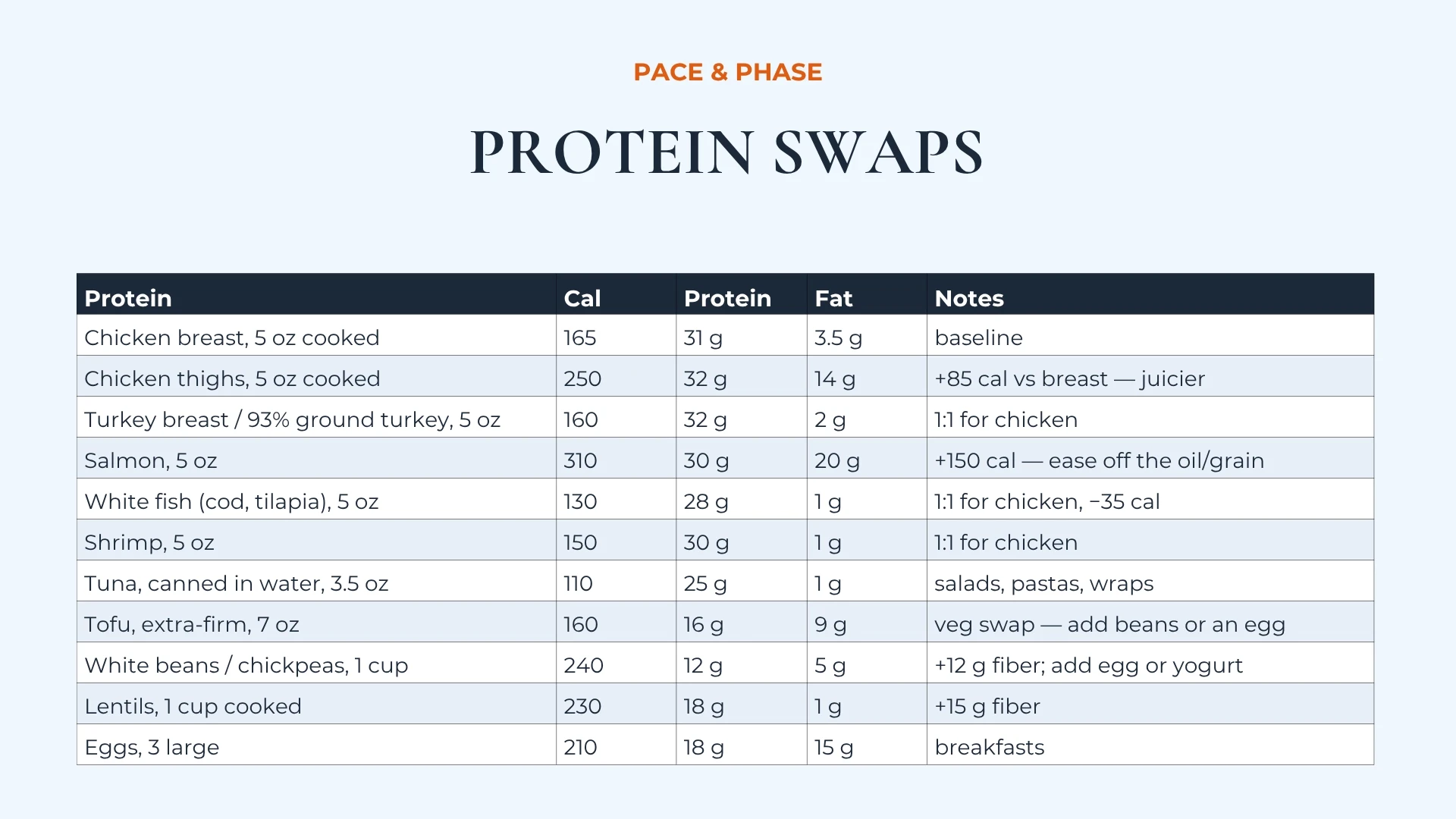
Rotate the list and the number takes care of itself.
You don't have to do this math yourself
Here's the honest truth: knowing your number and hitting it every day are different sports. Pace & Phase does the first part for you — it calculates your personal protein target from your weight, age, and goals, and adjusts it as those change. Then it handles the second part: gentle reminders through the day so your protein doesn't all land at dinner, and a post-workout check that nudges you to get 30 grams within 30 minutes of training. One less thing to track in your head.
If there's one thing to take from this chapter, it's that protein is a range you live in, not a number you hit. Eat it at every meal, spread it across the day, most days — that's the entire system. And if you want the version where you never think about it at all, that's the 130-gram playbook.
Key Vocabulary
RDA (Recommended Dietary Allowance) — the official minimum to avoid deficiency. A floor, not a goal.
Anabolic resistance — muscles responding less strongly to protein as you age; why needs rise after 40.
Leucine — the amino acid that triggers muscle building; the reason whey beats most plant powders per scoop.
Bioavailability — loosely, how usable a protein is: not just absorbed, but rich in the right amino acids.
Daily Value (DV) — the FDA's reference on US labels (50 g for protein), based on a generic 2,000-calorie diet — not on you.
Frequenly Asked Questions
Do I need the same amount on rest days?
Essentially yes. Muscle repair happens between workouts, not during them. Keep it steady all week.
What if I'm vegetarian?
The rule doesn't change — only the sources. Combine legumes, dairy, eggs, and soy across the day; the tricks above do half the work.
Which powder should I actually buy?
Whey concentrate, unless dairy bothers you (then isolate) or you're plant-based (then a pea-rice blend or soy). 20+ g per scoop, tested, no proprietary blends.
I've heard high protein harms kidneys. True?
In healthy adults, studies haven't shown kidney problems from protein in these ranges. If you have kidney disease, please consult with your a doctor.